
"Leonardi Di Caprio as Jordan Belfort in The Wolf of Wall Street, outside at the pier, throwing money in the air smiling as he thinks they are fun coupons" - https://app.leonardo.ai/Prologue: I’ve been a bit of a grumpy curmudgeon for a while now on LinkedIN when it comes to conversations about AI. That could lead to the misunderstanding that I don’t see the value of what is currently happening. This is absolutely not the case so I thought it was about time I summarized some of my current thoughts. They might change, maybe even later today. Strong opinions, loosely held.
Technology-forward hype cycles
In 2017, I was smack in the middle of the whole Distributed Ledger Technology (DLT) craze where EVERYTHING was going to be Web3 going forward. Decentralised trust systems and automated smart contracts with micro-payments, … we were going to make away with the notaries, the banks, or even the governments. We were going to cut the middle man everywhere and only have automated shared infrastructures with built-in trust systems. Billion and billions of money has been spent selling us the idea we had entered a new era of the internet and you were missing out if you didn’t adopt immediately. Today, DLTs are almost exclusively back to just do what they were originally designed for; cryptocurrency. And even then, al the ‘token-based services’, using tokens as payment has not really hit the market broadly. I know I’m not using DLTs to create contracts, and not even to buy bread.
This is a pattern in technology-forward hype cycles. One of my biggest gripes with this type of cycles over the last few decades is that their speed of adoption is dictated by monetary return for investors rather than the needs of the market. But in reality they are merely the next iteration of the already possible and the actual adoption rate follows the proven value over time.
Generating net new value
As en entrepreneur, we (should) think in terms of building sustainable business models. Sustainable businesses are built on creating net new value repeatedly. Solving the pains of yesterday in ways that were previously impossible. With these technology-forward hype cycles we jump from “can we make it work?” to “can we make it repeatable?” without properly going through the “does it bring any value” stages?
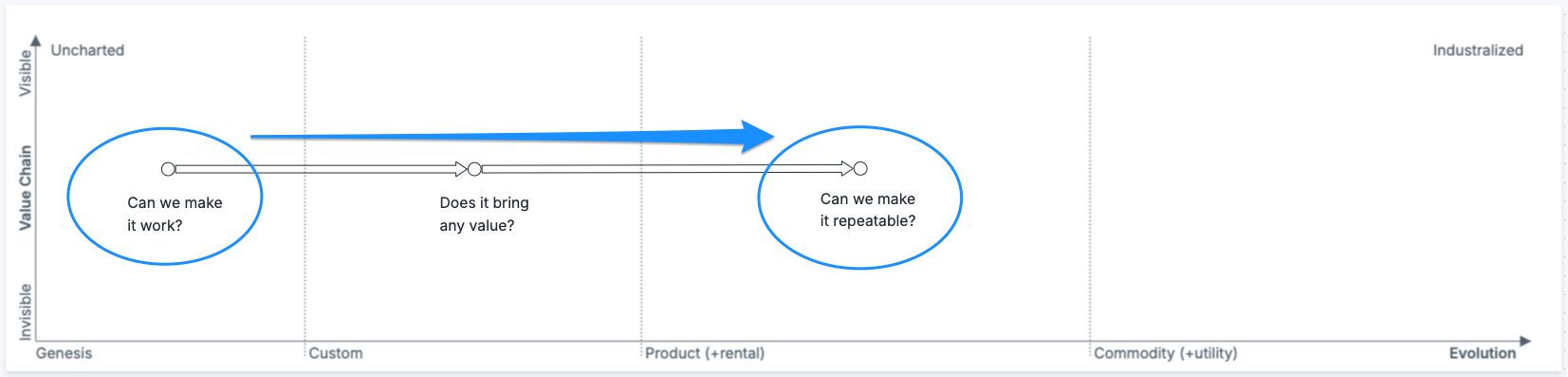
Any form of technology (not limited to information technology) goes through these stages of evolution. So yes, although we currently have new ways of interacting with our data through LLM/GenAI technologies that ‘work’, we are still facing the old ‘WHY?’ question. Is what we are generating with said technologies systematically adding net new value we could not create otherwise and is the cost (incl risk) of doing that worth it?
This is the mistake we made during the DLT/Blockchain cycle: we were solving technical problems that nobody really wanted to pay the real costs for. Even if these solutions were far more sophisticated. The problem wasn’t urgent enough and the bottomline gains not big enough.
We are seeing very similar things happening right now in AI. One of the first signs of change is going to be the cost: the real infrastructure costs of running AI are still not being pushed through to the clients. The complexity of the problems it can solve today is really low and the costs to increase this (calculation cost and token cost) is exponentially bigger with every step forward. This is not a lineair problem. At some point in the very near future we are going to be faced with a big split: lowering our expectation of what these tools can deliver, or paying much bigger prices for greater complexity. And frankly: I expect it to be both.
Investment prediction: almost none of this ARR growth is truly Recurring today! It’s mostly still in investigation mode and the vast majority of it is going to churn.
Some musings on the types of AI
Chat…
Everybody is using the conversational chatbots including me. They truly are the next generation of search. The best part of it is the iterative questioning aspect where you can go back and forth and challenging the results to go deeper. Iterative search was previously not possible. We do need to learn to expect less from these systems though. Especialy with what they ‘generate’. The best way to look at it today is that every time you open a new chat, you are talking to a new junior researcher/engineer/bank clerk/… They may give you a headsup to the first stages of your research but you have to validate their findings yourself. Like you (hopefully) also did with your own Google search results. Trusting a GenAI chatbot is like only clicking on the first link in your Google Search; sometimes you’ll be lucky, mostly you won’t.
Agentic AI
Which brings me to Agents. Agentic AI realy is also really no more than the next version of Robotic Process Automation (RPA). The difference here is the non-deterministic language interface. If there is ONE THING that LLMs have brought to us that is a new higher order system; it’s non-deterministic interfaces. Where systems can interpret what is asked from them without being explicit in a predefined syntax (language). This both towards people and systems alike.
BUT, here I ask you especially when it’s system to system interaction; look very well to what we already have today in automation. Make the comparison to blockchain vs other existing encryption methods. How much new risk are we introducing against the net new value generated? Is it necessary enough? Where are we making a real difference?
What I am looking forward to more is that human/machine interaction where I can make a system do what I want without having to learn how the system works. Combining the chatbot with the agent. This evolution was and is very welcome and is truly creating net new value.
“I want AI to do my laundry and dishes so that I can do art and writing, not for AI to do my art and writing so that I can do my laundry and dishes.” Joanna Maciejewska [link].
Artificial General Intelligence (AGI)
I am still very, very sceptical about the whole Artificial Super Intelligence (ASI) premise. The whole AGI is coming feels too close to the Web3 is going to change everything craze. Yes, we have made a big leap over the past two years, but we are hitting a plateau of net new possible pretty soon now. The models are going to get better, yes. And the calculations are henceforth becoming cheaper. But do not underestimate the complexity of the human brain. We are no-where close to understanding how the brain actually works from a neurological perspective, let alone imitating it with technology. The speed of which our gut-feeling reacts with the amount of variables it uses to do that is astonishingly more complex than chatbots and agents. And again; this is not a lineair progression step. Systems will increasingly get better at the calculation capacity of the brain, but the complexity capacity is still very faaaar away.
The turing test was a dumb test. That goalpost stood way too close. Faking that you seem human towards another human is not that hard if you look at it from a complexity perspective. Yes, ‘reasoning’ is going being part of what’s next, but whatever AGI is going to be, it is most probably just going to be iterations of the already possible. Future iterations of the Robotic Process Automation so to speak.
Within AGI we are still only at the ‘can we make it work?‘ questions, and time is still on your side. Don’t give in on the techbros and their investors induced anxiety. Let’s solve real problems first with sustainable business models!
PRO TIPS:
If you are still listening and haven’t tuned out because you think you know better, good! Then you’ll probably be OK sticking around for a couple of pro-tips:
- KNOW YOUR PROBLEM! What hurts the most to the business that you are trying to solve with AI? Production losses? Delivery delays? Service or product quality? Employee turnover rate? What are the alternatives to solve your problem? How much more expensive are these alternatives and why are they not working?
- 99% of all GenAI implementations today will be vastly outdated (and/or dead) in 24 months. Invest in what already brings value today. The market will evolve and the winners are not chosen just yet.
- Do NOT scale in production. Confirm that it works first, confirm that it brings P&L value second, and then go out into the market and research who is going to be your best partner for the changes to come!
If you are an AI solutions vendor; do these exact things for your customers. No better way today to gain trust from a client than to share their anxieties. Because I know you are faking your confidence. And if you are not faking your confidence, please go here first; LINK
“Time is on my side”
brilliantly used in the movie “Fallen” – original by The Rolling Stones –